Thailand's enterprise AI story is no longer about whether to adopt — it's about whether organizations can survive the gap between a promising demo and a system that actually runs in production. In 2026, that gap is where careers are made and budgets are burned.

According to the International Trade Administration, Thailand's generative AI market is projected to reach $312 million in 2025 and grow at a 41.5% CAGR through 2030, reaching $1.8 billion. But behind the headline figures, the more honest story is one of fragmented pilots, architecture debt, and a thin pool of engineers who know how to move a model from notebook to production at scale.

This article is for the CTOs, engineering leads, and digital transformation officers who are past the "let's explore AI" phase and asking a harder question: how do we actually ship this?

The Reality Gap: POC vs. Production

Most Thai enterprises — in banking, government, and telecom — have run at least one AI proof-of-concept in the last 18 months. The problem is that very few have made it to production.

Deloitte's 2026 Banking and Capital Markets Outlook is direct: "Many AI initiatives are trapped at fragmented proof of concept, especially Generative AI." Thai banks announced over 25 billion baht in AI investment in 2024, yet a 2025 study by Evident found only 4 out of 50 global banks reporting realized ROI from AI use cases.

Why do pilots stall?

  • Organizational silos. AI teams build in isolation, disconnected from the IT systems and business units that would actually use the output.
  • Data readiness. Thai enterprise data is often stored in legacy formats or siloed across departments, making it hard to ingest into any AI pipeline.
  • Compliance uncertainty. Teams know they need guardrails but aren't sure what "compliant" means for a model generating freeform text.
  • Handoff failure. The data scientist who built the POC lacks the MLOps or SRE background to productionize it.

"The defining challenge ahead is scaling AI initiatives into aligned, organisation-wide implementation — not running more isolated experiments."
— Deloitte Southeast Asia, Banking and Capital Markets Outlook 2026

The enterprises making real progress have stopped asking "can AI do this?" and started asking "what architecture and team structure do we need to run this reliably for the next three years?"

4 Use Cases Thai Enterprises Are Actually Deploying

4 use case ของ AI/LLM ที่องค์กรไทยใช้ใน production: RAG, chatbot พร้อม guardrail, code generation และ report generation
สี่รูปแบบที่ผ่านด่าน POC ไปสู่ production ได้จริง

1. Document Intelligence & Internal Knowledge Retrieval (RAG)

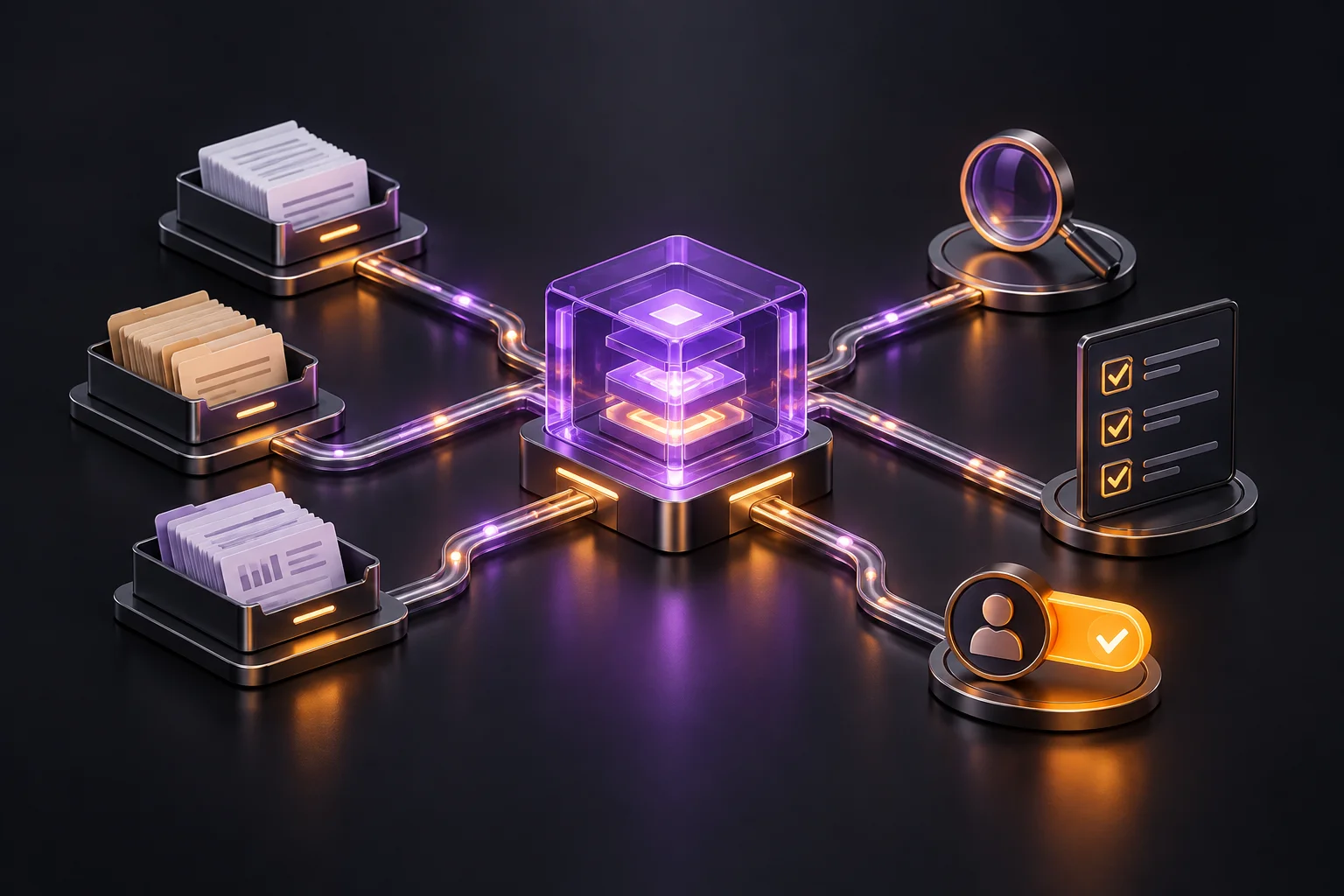
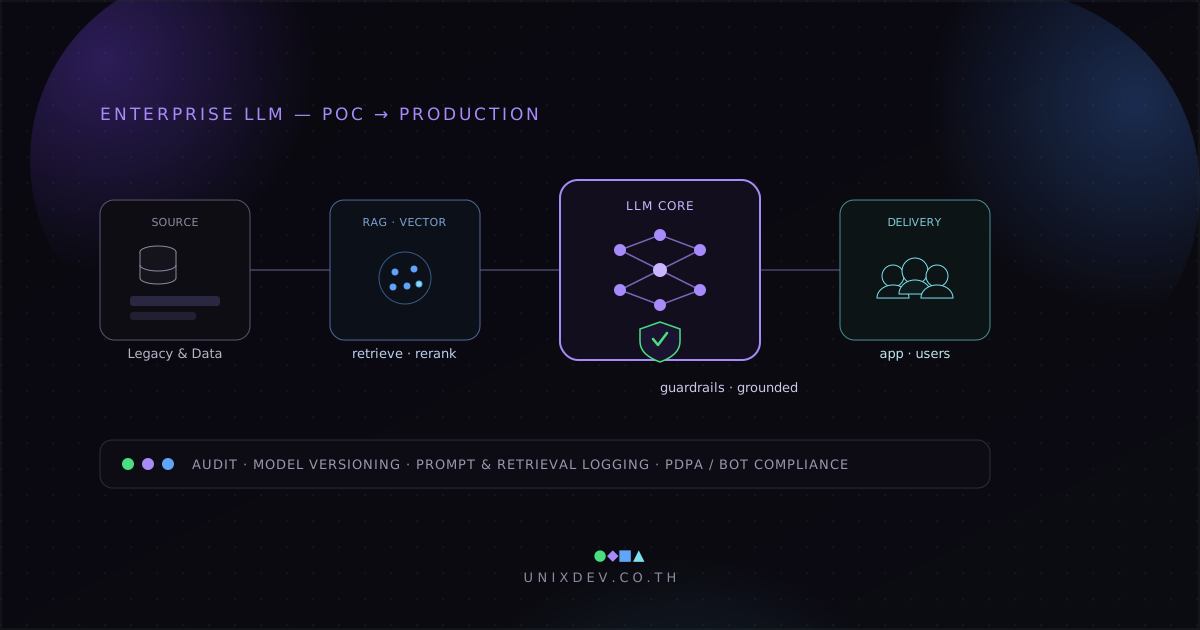
Retrieval-Augmented Generation (RAG) is arguably the most production-ready AI pattern for Thai enterprises today. The use case is straightforward: employees ask questions in natural language, and the system retrieves answers grounded in the organization's own documents — policy manuals, regulatory guidelines, technical specs, contract repositories.

For government agencies and large corporations, this replaces hours of manual search with a reliable, auditable Q&A interface. The RAG architecture solves a critical enterprise requirement: the model only generates responses based on your verified data, not its training corpus — which matters enormously when accuracy and traceability are non-negotiable.

The enterprise RAG market reached $1.94 billion globally in 2025 and is projected to reach $9.86 billion by 2030 at a 38.4% CAGR. Production RAG in Thai enterprises typically involves hybrid retrieval (vector + keyword search), reranking layers, and Thai-language embedding models to handle the nuances of Thai text.

2. Customer-Facing Chatbots with Compliance Guardrails (Banking & Telecom)

Customer service automation is the most visible AI deployment in Thailand's banking and telecom sectors. But the chatbots that are actually surviving in production are not the naive, prompt-and-respond systems from 2023. They are systems with:

  • Compliance layers that filter responses against regulatory constraints (Bank of Thailand guidelines, PDPA requirements)
  • Confidence thresholds — the system escalates to a human agent when it is not certain, rather than hallucinating an answer
  • Audit logging — every interaction is recorded with the retrieved context and model version used, enabling post-hoc review

Models like GPT-4o, Claude 3.5/3.7, and Gemini 1.5/2.0 are commonly evaluated in this space for their multilingual capability and instruction-following precision. For organizations with stricter data residency needs, open-weight models like Llama 3 running on private infrastructure are increasingly a viable alternative.

The key engineering challenge here is not the LLM itself — it is designing the intent classification, fallback handling, and human-in-the-loop escalation flows that make the system trustworthy enough to put in front of millions of customers.

3. Code Generation & Developer Productivity Tooling

Enterprise development teams in Thailand are quietly achieving significant productivity gains through AI-assisted coding tools. This includes both commercial tools (GitHub Copilot, Cursor, JetBrains AI Assistant) and internal deployments of code-focused models integrated into self-hosted CI/CD environments.

The production use case goes beyond autocomplete. Teams are deploying AI systems that:

  • Generate boilerplate for internal frameworks and conventions
  • Perform automated code review against internal standards
  • Draft unit tests from function signatures
  • Translate legacy COBOL or older Java codebases into modern equivalents — a particularly relevant use case for Thai banks and government agencies running decades-old systems

Security-conscious enterprises tend to route code generation through a self-hosted model (often Llama 3 or a fine-tuned Code Llama variant) to avoid sending proprietary source code to third-party APIs.

4. Automated Report Generation & Data Summarization for C-Level

Executive reporting is time-consuming and repetitive. AI is now doing the first draft. Structured data from BI systems or analytics platforms is piped into an LLM with an engineered prompt template; a human editor reviews and signs off before distribution.

Use cases include monthly operational summaries, regulatory submissions, board pack narratives, and real-time alerts with AI-generated context. For Thai enterprises in regulated industries, the workflow is: LLM drafts, human approves, system logs the chain of custody. This is not replacing analysts — it is freeing them from mechanical formatting work so they can focus on interpretation.

Key Technical Challenges Specific to Thai Enterprises

4 ความท้าทายเฉพาะขององค์กรไทย: คุณภาพภาษาไทย, data sovereignty / on-premise, การ integrate ระบบ legacy และ AI governance
สี่จุดที่ทำให้โปรเจกต์ AI ในไทยสะดุดบ่อยที่สุด

Thai Language Quality in LLM Responses

Thai is a low-resource language compared to English or Mandarin, and this creates real problems in production. General-purpose LLMs often tokenize Thai inefficiently — research on the Typhoon Thai LLM found that standard tokenizers require up to 3.8× more tokens to encode Thai text compared to Thai-optimized tokenizers. This affects both cost and latency at scale.

Beyond tokenization, Thai cultural and contextual understanding in most multilingual models is limited. Evaluations using the ThaiCLI benchmark — which tests cultural alignment and linguistic nuance — consistently show that even high-performing multilingual models score lower on Thai cultural comprehension than on general reasoning tasks.

For production systems serving Thai users, this means investing in: Thai-specific embedding models for RAG, careful prompt engineering in Thai, and systematic evaluation using Thai-language test sets — not just English benchmarks.

Data Sovereignty & On-Premise LLM Requirements

Regulated industries in Thailand — banking, insurance, government — face strict requirements around where data is processed and stored. The Personal Data Protection Act (PDPA) and sector-specific guidelines from regulators like the Bank of Thailand and NBTC constrain which cloud services can process customer data.

This pushes many organizations toward on-premise or private-cloud LLM deployments. In 2026, this is genuinely feasible. Llama 3 (70B and larger) running on GPU infrastructure delivers performance competitive with GPT-3.5 for many structured tasks, and open-weight models can be fine-tuned on internal data without that data ever leaving the organization's network.

The tradeoff is operational complexity — an on-premise LLM requires GPU infrastructure, model management, and the MLOps capability to update and monitor it. That is not a small investment.

Integration with Legacy Systems

The majority of Thai enterprises in banking and government run core systems that are decades old — mainframe, COBOL, older J2EE stacks. Connecting an AI layer to these systems requires reliable data pipelines, often involving real-time extraction from databases that were never designed for API consumption.

This is frequently underestimated at the POC stage. In production, a RAG system is only as good as its data ingestion pipeline. If documents aren't being updated when source systems change, the model's answers go stale. If the pipeline drops records, the model confidently answers from an incomplete knowledge base.

The integration layer between legacy data and the AI stack is often where projects fail — and where experienced software engineers are more important than ML researchers.

AI Governance & Auditability Requirements

As AI systems touch customer decisions — loan approvals, service recommendations, escalation routing — regulators and enterprise risk teams are asking hard questions about auditability. Who can explain why the model said what it said? What version of the model was running? What data was retrieved?

Production AI systems in regulated Thai enterprises need to implement: model versioning, prompt logging, retrieval context recording, and anomaly detection on model outputs. This is not optional — it is the infrastructure that makes the system defensible when something goes wrong, and something always eventually goes wrong.

What to Look for in an AI/LLM Engineering Partner

Choosing a partner to build production AI systems is different from choosing one to run a workshop or deliver a demo. The questions that matter:

Can they ship? Ask for production case studies — not slide decks with architecture diagrams, but deployed systems with real users, uptime records, and post-launch iteration history.

Do they understand your compliance environment? A partner who has only deployed AI in SaaS startups will not have the reflex for PDPA, BOT guidelines, or government security frameworks. These are not bolt-ons — they shape architecture decisions from day one.

Can they handle Thai language at scale? Verify their approach to Thai tokenization, Thai-language evaluation, and Thai-specific RAG tuning. This is a specialization, not a default capability.

Do they own the full stack? LLM engineering intersects with infrastructure (GPU provisioning, networking), data engineering (pipelines, vector stores), software engineering (APIs, UI), and MLOps (model monitoring, versioning). A team that only covers one of these layers will create coordination problems in production.

UNIXDEV Co., Ltd. has been building and operating complex software systems for Thai enterprises since 2013 — across government, banking, telecom, and media — with ISO 9001:2015 and ISO/IEC 29110 certification and experience across approximately 308 projects for 71 organizations. AI/LLM Engineering is one of our core service lines, and we bring the same production discipline — infrastructure, DevOps, integration, compliance — to AI deployments that we apply to every other system we build.

Conclusion: Production Is the Hard Part

The inflection point for Thai enterprise AI in 2026 is not about awareness or even capability — it is about execution. The models exist. The use cases are proven. The organizations willing to invest are numerous.

What separates the enterprises that are shipping AI in production from those still running their fourth pilot is: architecture discipline, integration depth, compliance rigor, and an honest accounting of the operational work required to keep a model running reliably.

If your team is at the point where a POC has proven value and you need to move toward production — with Thai language support, data sovereignty controls, legacy system integration, and governance built in — we'd like to help.

Start a conversation with the UNIXDEV team →


UNIXDEV Co., Ltd. — Craft code · Ship systems · Scale impact
ISO 9001:2015 · ISO/IEC 29110-4-1:2018 · Founded 2013 · unixdev.co.th