
Digital transformation: start from a business problem and plan the first 90 days
Start digital transformation from one business outcome and one value stream, assess readiness, measure against a baseline and plan the first 90 days.
By UNIXDEV Team · 4 min read
Original published · English edition
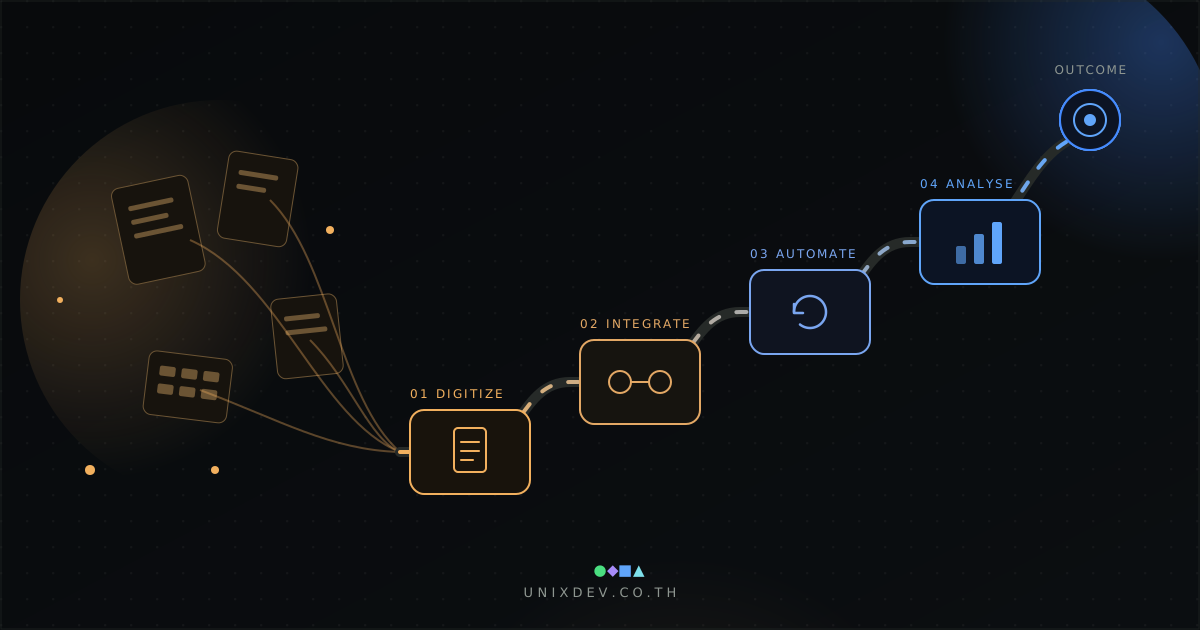
Many organisations are told to "do digital transformation" and the first meeting turns into a debate about which system, cloud or AI tool to buy. The more important questions are what the business needs to change and which work should change first.
The readiness framework, scoring table and examples below are UNIXDEV's practical guidance, not a formal standard or customer results.
Transformation is not a software purchase
The 2015 MIT Sloan Management Review and Deloitte study concluded that strategy, not technology, drives digital transformation. Ask first: when this is done, who works differently, and which business number should move? Until that has an answer, choosing software can wait.
One outcome, one value stream
Choose an outcome leaders agree matters, such as shorter time from quote request to quotation, then the value stream that drives it. Follow one real piece of work from request to completion, recording the people, systems and waiting along the way. Separate working time from waiting time; much work takes minutes to do but days to approve.
Assess readiness in five dimensions
Assess only the chosen value stream, with the process owner and IT scoring each dimension from 1 to 5 together:
- Process: is there an owner and an agreed way of working?
- Data: is master data correct, and do people know where it lives?
- Systems and integration: do systems exchange data, or is it exported and re-keyed?
- People and skills: do users have time to learn and someone to help them?
- Governance: who approves scope, budget and data access?
The lowest score is not a reason to stop. It belongs at the start of the plan.
Sequence the technology work
- Digitize forms, emails and passed-around files into structured, owned records. See digitizing documents and approvals.
- Integrate sales, inventory and accounting to remove re-keying. See legacy modernization.
- Automate approvals, alerts and document generation; automation on wrong data spreads errors faster.
- Analyse and apply AI once data is complete and trusted. See choosing an AI agent pilot.
People are the real bottleneck
A system nobody uses is not a transformation. At individual level, Prosci's ADKAR model separates awareness, desire, knowledge, ability and reinforcement, which helps diagnose why trained users still work the old way. At organisation level, Kotter's 8-step process stresses a guiding coalition and short-term wins; business leadership and one visible result are the steps most often skipped.
Measure from a baseline
Record the baseline before building. Track leading indicators, such as the share of work done in the new system or approval waiting time, alongside lagging business results, such as customer response time or cost per transaction. Business numbers move slowly; leading indicators show earlier whether the change is taking hold.
A hypothetical scoring example
A fictional distributor wants faster customer responses without adding staff. It scores four ideas on goal impact (×3), data readiness (×2), results within 90 days (×2), an available owner (×2) and low risk (×1). Automated quotations with live price and stock score 41 of 50; online expense approval scores 35; a website chatbot and an all-systems executive dashboard score 25 each because the data is not ready. The quotation project wins, with price and product-code clean-up added to its plan.
The first 90 days
- Days 1–30: choose the outcome, name business and IT owners, map the current state, assess readiness and collect the baseline.
- Days 31–60: design the future state, build a small first version, pilot it with one team supported by a key user, and collect feedback weekly.
- Days 61–90: compare results with the baseline, communicate the short-term win, then decide to expand, adjust or stop.
Agree the expand, adjust or stop criteria on day one, before results arrive.
Common failure patterns
- Buying a tool before defining the problem.
- Starting many initiatives at once, so none shows a clear result.
- No business owner, so IT delivers to specification but work does not change.
- Automating or adding AI on top of poor data.
- Pilots with no decision criteria that never end.
When the target process is clear, UNIXDEV can design and build systems around it through custom software development, or start with internal documents and approvals through digital workplace platforms.