
AI and LLMs in Thai enterprise systems: moving from pilot to production
A practical look at retrieval, assistants, developer tools and reporting, with the evaluation, access and operational work needed for production.
By UNIXDEV Team · 3 min read
Original published · English edition
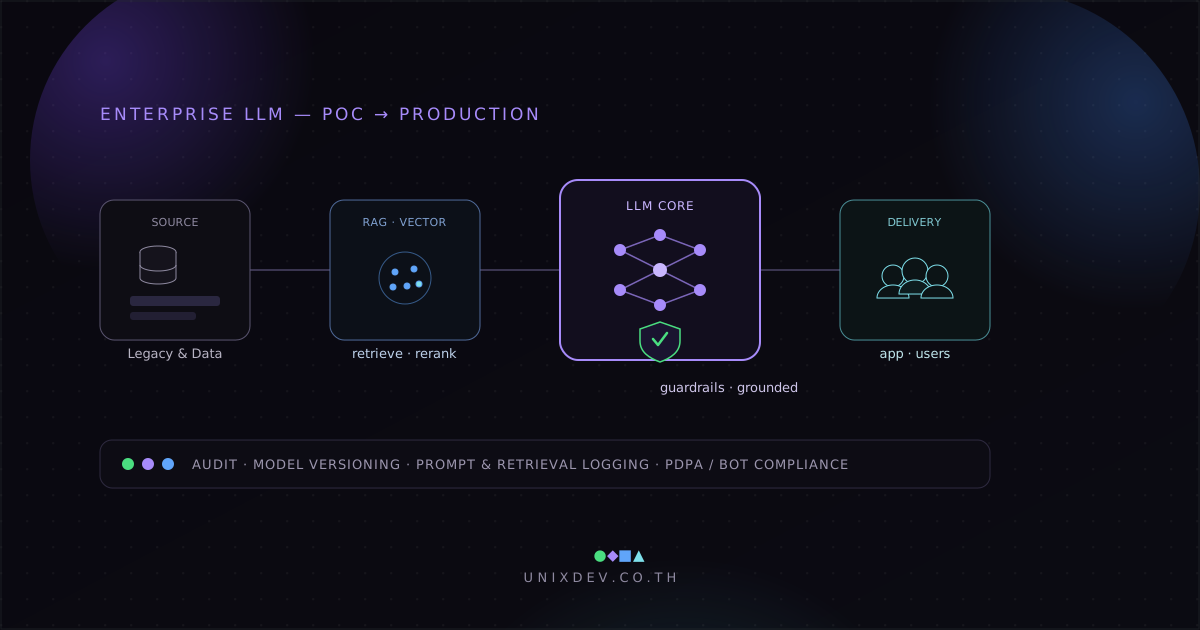
A convincing AI demonstration is not yet an operating service. Production requires a repeatable way to evaluate quality, control access, manage cost and respond when the model or a connected tool fails. This article examines deployment patterns; it is not a survey of adoption rates or a claim about named customer projects.
The gap between a pilot and production
A pilot often uses a small, clean data set and a knowledgeable operator. Real users bring ambiguous questions, outdated documents, missing fields and different permissions. The application also needs identity, logging, monitoring and an owner who can decide when an output is unacceptable.
Four use cases to evaluate
Document intelligence and retrieval
Retrieval-augmented generation can bring approved documents into the context used to answer a question. Build around document ownership, freshness, permissions and source references. Test questions with no answer and questions whose answer is in a restricted document. Retrieved text is evidence to assess, not a reason to trust every generated statement.
Customer-facing assistants
Start by defining what an assistant may answer and when it must escalate. Product terms, account information and actions need reliable sources and access checks. A helpful fallback and human review can be more valuable than broad autonomy. Treat messages and retrieved content as untrusted input when they could influence tool use.
Developer assistance
Code generation can help with drafts, tests and exploration. Developers still need to review security, behavior, licenses and maintainability. Evaluate useful completed work, including the time spent checking and fixing output, rather than counting generated lines.
Reports and summaries
Summarization can help an executive or operational team work through source material. Preserve links to the underlying records, validate calculations outside the language model and distinguish missing evidence from a confident-sounding conclusion.
Requirements that deserve particular attention in Thailand
Thai-language quality
Evaluate the actual terminology, document styles and code-switching found in the organization. A general benchmark does not establish accuracy on official language, technical terms or the team’s own abbreviations. Build a reviewed test set and keep difficult cases for regression testing.
Data handling and location
Understand what information leaves the application, how providers handle it and which contractual or regulatory requirements apply. Self-hosting may be an option, but it brings responsibility for model serving, capacity, security and updates. It is not automatically the best choice for every sensitive workflow.
Existing systems
Legacy APIs and data models can be a larger constraint than the model. Define identity, idempotency, timeouts and failure recovery before allowing an assistant to modify operational records. Begin with read-only or draft output when the consequences are not yet understood.
Governance and auditability
Version prompts and configuration, keep an appropriate record of tool actions and identify who approves releases. Decide what information should be logged and how long it should remain accessible. Review changes to the model or retrieval pipeline against the same acceptance criteria.
Choosing an engineering partner
- Ask how they define acceptance and test failures.
- Review how permissions are enforced outside the model.
- Ask what the operating cost includes and how it is monitored.
- Check the human escalation and incident process.
- Agree source, configuration and knowledge handover.
Begin with a bounded AI engineering scope and a measurable decision. The companion pilot and ROI guide includes an illustrative calculation. For a primary discussion of design patterns, see Building effective agents.