
SRE vs DevOps: different responsibilities, a shared goal
Understand DevOps, service-level indicators, objectives and error budgets, and decide what reliability work your team actually needs.
By UNIXDEV Team · 3 min read
Original published · English edition
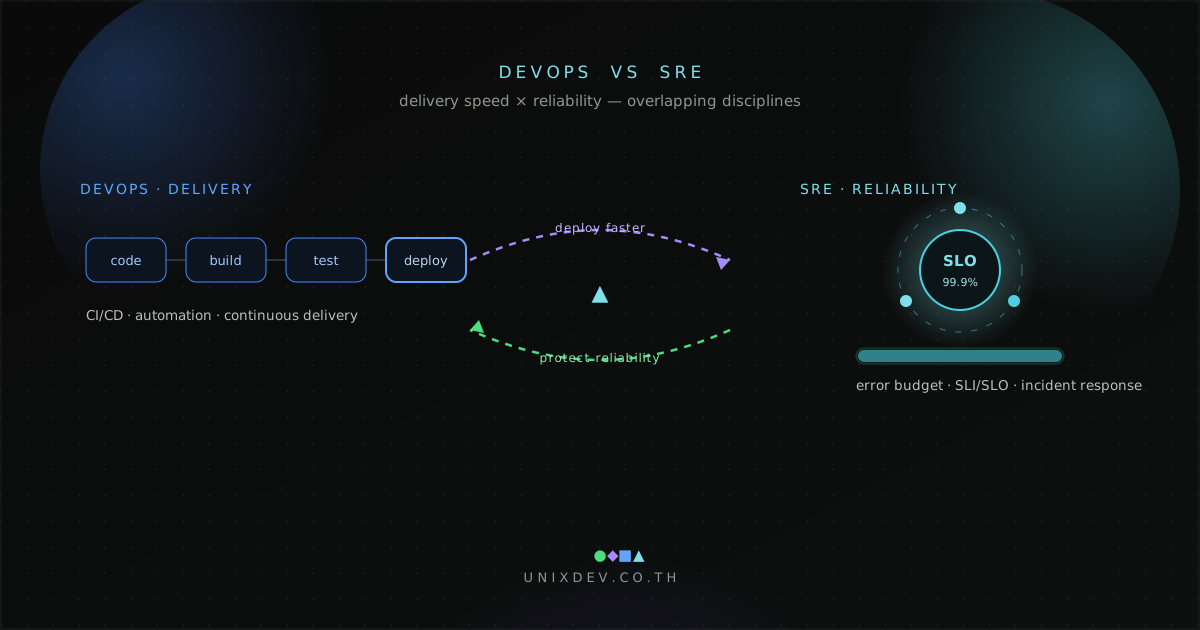
DevOps and SRE are often used as job titles for the same collection of tasks. A clearer distinction helps a team decide how to release changes and how to keep the service dependable.
What DevOps addresses
DevOps brings development and operations closer together through shared responsibility, shorter feedback loops and repeatable delivery. CI/CD, infrastructure as code, testing and observability support that way of working. Installing a pipeline does not resolve unclear ownership or a difficult release process by itself.
What SRE adds
Site reliability engineering applies engineering to the operation of a service. It gives teams a way to define acceptable reliability, measure it and balance reliability work against feature delivery. Reducing repetitive operational work is part of that job.
Service-level indicators
An SLI is a measurement of service behavior, such as the proportion of successful requests or requests completed within a latency threshold. Select indicators that reflect the user experience and define the measurement boundary.
Service-level objectives
An SLO is a target for an indicator over a specified window. “99.9% successful eligible requests over 30 days” is more precise than “the system should be stable.” An internal SLO is not automatically a contractual SLA.
Error budgets
The error budget is the allowed gap between the objective and perfect performance. For a time-based 99.9% availability objective over 30 days, 0.1% is 43.2 minutes. A request-based objective instead uses a proportion of requests; do not convert it into downtime without checking the definition.
Agree an error-budget policy before an incident. It can guide when to slow risky releases and prioritize reliability work. It is a shared decision rule, not a license to cause failures.
How the responsibilities compare
| Question | DevOps emphasis | SRE emphasis |
|---|---|---|
| How do we deliver? | Collaboration, automation and feedback | Delivery within explicit reliability goals |
| What do we measure? | Delivery flow and operational outcomes | User-facing indicators, objectives and toil |
| How do we improve? | Remove delivery bottlenecks | Engineer away recurring reliability problems |
Does every organization need an SRE team?
No. Start with the importance of the service, incident load, operational complexity and available skills. A small team can adopt useful SLOs and incident reviews without creating a separate department. Dedicated SRE work becomes more valuable when repeated operational effort or reliability risk justifies it.
Build the capability internally or work with a partner?
An internal team retains close product context. A partner can supply specific operational experience and coverage. In either case, agree ownership, access, on-call expectations, escalation and how knowledge returns to the team. Outsourcing does not remove the need for a service owner.
When discussing DevOps and managed services, ask which responsibilities are being provided and which remain yours. For the underlying reliability concepts, see the Google SRE Workbook on implementing SLOs.