
Website development or custom software: which does your organization need?
Compare content websites and business applications by workflow, data, integration, ownership and ongoing support, then choose an appropriate first scope.
By UNIXDEV Team · 2 min read
Original published · English edition
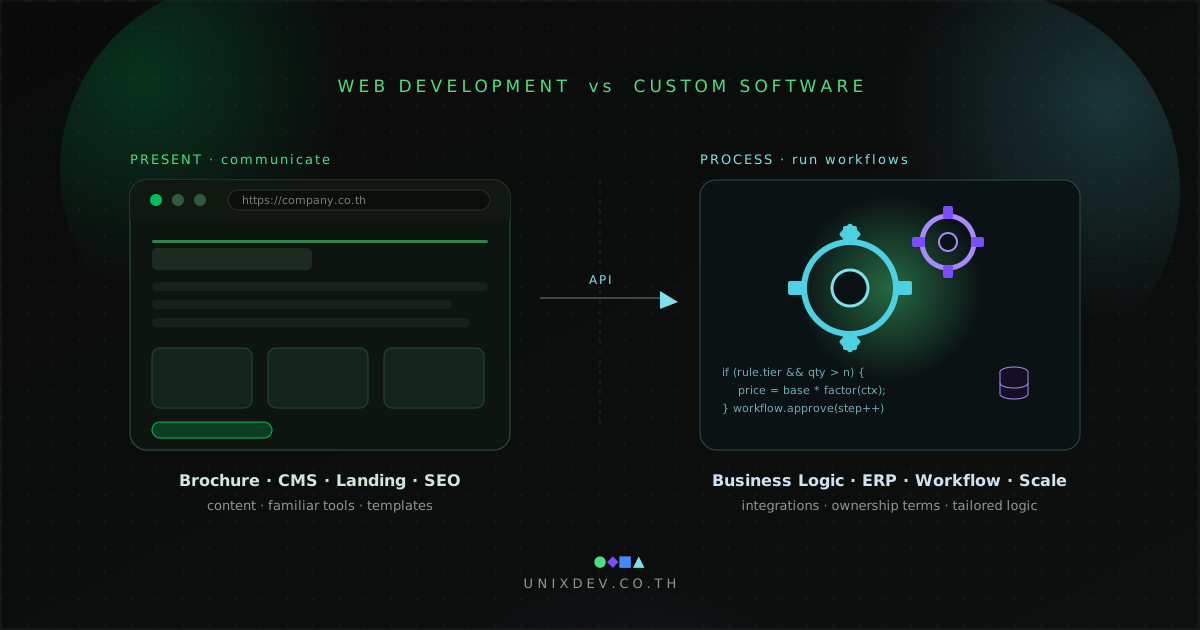
A website and a business application can both run in a browser. The useful distinction is the work they perform, not the technology used to display them.
When website development fits
A content-focused site helps people learn about an organization, find products, read articles or make contact. A suitable CMS can give editors control without requiring a custom application for every page. Design, accessibility, content structure, search visibility and editorial maintenance are central concerns.
When custom software fits
A business application manages a process: approvals, calculations, transactions, permissions or exchanges between systems. Its design begins with the workflow, data and exceptions. A polished interface is important, but the application also has to enforce rules and preserve useful records.
Compare six dimensions
| Dimension | Content website | Business application |
|---|---|---|
| Primary purpose | Communicate and help visitors act | Carry out and record work |
| Content and data | Pages, media and editorial structure | Business records and relationships |
| Users | Visitors and editors | Roles with different permissions |
| Integration | Selected marketing or content tools | APIs and operational dependencies |
| Acceptance | Content, usability and technical checks | Workflow outcomes and failure cases |
| Ongoing work | Publishing, updates and site care | Operations, rule changes and support |
Five needs that often suit a website
- A company profile with service and contact pages.
- A publishing or news site.
- A campaign landing page.
- A product catalogue without complex transactional logic.
- A recruitment or information site with manageable editorial workflows.
Five needs that point toward an application
- Approval flows with multiple roles and exceptions.
- Operational data shared between departments.
- Customer or partner portals with individualized access.
- Integration that creates or updates business records.
- Calculations and reporting governed by business-specific rules.
A hybrid approach is common
An organization may need a public CMS site and a separate operational application. Shared identity or APIs can connect them where necessary. Keeping responsibilities clear can reduce the risk of forcing a general-purpose CMS to perform work it is poorly suited to handle.
Questions before deciding
Who uses the system? What must they complete? What information is stored? Which decisions or actions require approval? What happens if a connection fails? Who will maintain content, code and infrastructure? These answers reveal more than a request for “a new website.”
There is no reliable price comparison without scope. Include design, integrations, migration, testing, licenses and ongoing care. Start with the smallest complete workflow that can be accepted, rather than an arbitrary feature count.
See custom software development for the delivery process, and our WordPress capabilities for content-oriented systems.