
Thai government IT procurement: e-GP, the TOR and maintenance budgets
From 1 Oct 2026, Thai selection and specific-method bids go through e-GP. A software TOR needs acceptance criteria, source code, PDPA terms and an MA budget.
By UNIXDEV Team · 8 min read
Original published · English edition
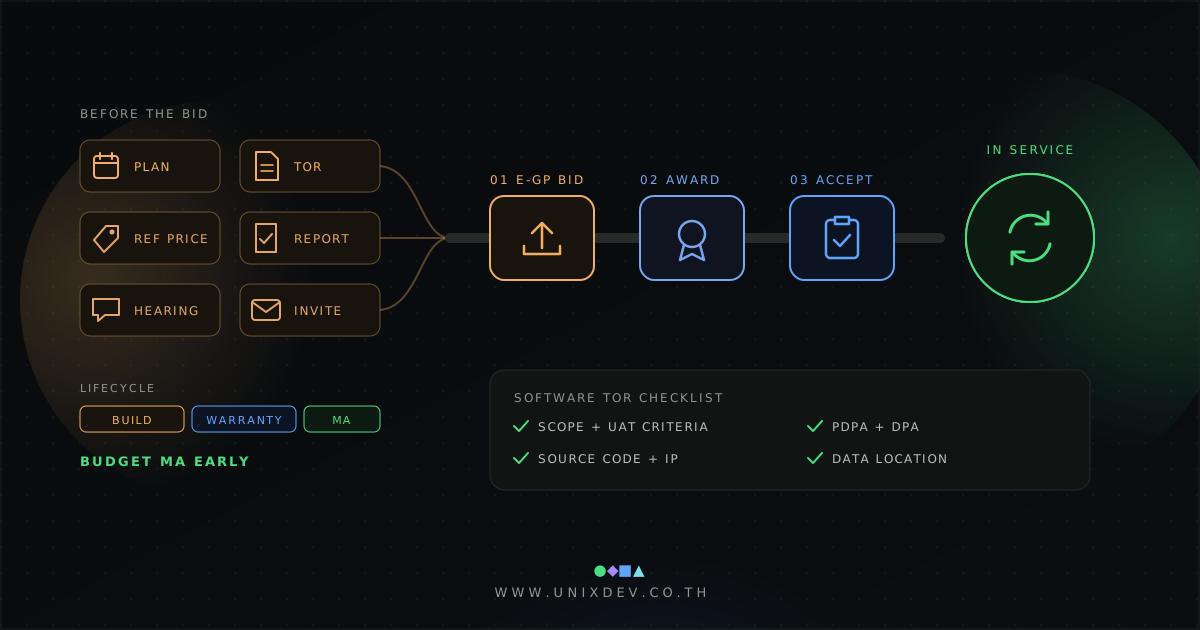
An agency has budget approval for a new system. The next questions arrive together: which procurement method applies, what changed in the e-GP system after CGD circular No. 0405.4/W 714, what a software TOR must say so the work can actually be accepted, and who maintains the system, from which budget, once the warranty period ends.
This guide is for Thai agency staff planning an IT or software procurement: procurement officers, IT teams and system owners. It cites the statutes and official documents we could verify. We do not repeat why public-sector IT projects fail; that is covered in why government IT projects struggle. Procurement rules for a real project should always be confirmed with the agency's procurement officer or the Comptroller General's Department (CGD).
Which procurement methods can an agency use?
Section 55 of the Public Procurement and Supplies Administration Act B.E. 2560 (2017), published in the Royal Gazette, vol. 134, part 24 Kor, on 24 February 2017 and in force 180 days later, sets out three methods. Under the general open invitation, any qualified operator may bid. Under selection, the agency invites at least three qualified operators, unless fewer exist. Under the specific method, it invites or negotiates with one operator. Section 56 requires agencies to try the open invitation first; selection and the specific method apply only in listed cases, such as no bids under an open invitation, specialised work with few capable operators, values within the ministerial-regulation limit, a single qualified operator, emergencies or follow-on work.
The Ministry of Finance procurement regulation B.E. 2560 (clauses 29 to 32) splits the open invitation further. e-market is for simple or standard items listed in the e-catalog: quotations above 500,000 up to 5,000,000 baht, e-auction above 5,000,000. e-bidding covers values above 500,000 baht for items not in the e-catalog, which usually describes bespoke software. Price inquiry covers above 500,000 up to 5,000,000 baht only where internet access is limited. These thresholds come from the 2017 text and may have been amended; check the current consolidated text with the Office of the Council of State before relying on them.
What changed in e-GP after circular W 714?
From 1 October 2026, selection and specific-method procurement must run through e-GP, from the invitation letter through bid submission, opening and choosing the winner, with exemptions such as purchases up to 500,000 baht, classified items, specific land or buildings, consultancy, construction design or supervision, and other cases in the guideline. Steps started before 1 October continue under the old process. The date and exemptions are taken from news reports of the CGD Director-General's announcement of 18 September 2026; check them against the full circular.
Circular W 714 is dated 16 September 2026 and was issued by the Procurement Problem-Ruling Committee; its companion, circular W 715 of the same date, covers electronic appeals. The attached manual sets out what bidders should know:
- Under selection, the agency invites at least three operators who meet its stated qualifications through e-GP, unless fewer exist.
- The agency sets one submission window: 09.00 to 12.00, 13.00 to 16.00 or 08.30 to 16.30, using e-GP system time.
- Each invited bidder can submit once, through e-GP, within the window.
- Bulky documents may be delivered to the agency later. Both that later delivery and any sample, test or presentation must be scheduled within 5 working days counted from the day after the bid date, and written into the invitation.
- Where technology makes offers hard to compare, the agency can require a separate technical proposal, which suits software.
- If the price exceeds the budget, negotiation runs through e-GP, and the winner is announced on the CGD and agency systems and emailed to all bidders.
Under W 715, news reports say appeals for e-bidding and selection are filed through e-GP within 7 working days of the result being announced.
What is the typical sequence?
Durations depend on method, value and readiness, so we give the order only.
- Budget approval, then the annual procurement plan is published on the CGD and agency systems (Act section 11). Regulation clause 11 says a project not published in the CGD system cannot be procured.
- A committee or official drafts the TOR and selection criteria (clause 21).
- The reference price is set under section 4, which lists six sources in order: Median Price Committee criteria, the CGD reference price database, Budget Bureau or central-agency standard prices, a market survey, the last price paid within two fiscal years, and other prices under the agency's own criteria. For bespoke software, the first or a market survey usually applies.
- The procurement request report states reasons, scope, reference price, budget, method and criteria (clause 22). For e-bidding, clause 45 has it submitted with the draft TOR to the head of agency for approval.
- TOR hearing where it applies (section 59). For e-bidding, clauses 45 to 47 leave it to the head of agency above 500,000 up to 5,000,000 baht and require it above 5,000,000, published for at least 3 working days.
- Invitation and bids through e-GP.
- Evaluation, approval, announcement and the appeal window.
- Contract on the standard form (section 93); terms that differ from the form, such as IP or data processing clauses, are allowed under the conditions in section 93, and some cases need Attorney General review first. The contract carries a ban on unapproved subcontracting (section 95), and its key terms are published (section 98).
- Contract administration and acceptance by the inspection committee (section 100).
- Warranty period: the custodian checks for defects and has the contractor notified to fix them (clauses 184 and 185).
What should a software TOR contain?
We recommend nine items. They are not a legal list, but the inspection committee under section 100 needs clear criteria to accept the work, so each item should be testable:
- Scope: users, processes, integrations and data migration.
- Acceptance and UAT: "done when..." per milestone, who tests and with which data. See our quote preparation checklist.
- Source code and IP: repository with history, build and deploy scripts, third-party licences, accounts in the agency's name. See the vendor handover checklist.
- Documentation: user, admin, architecture, API and recovery guides.
- Training: written as outcomes, such as admins restoring from backup themselves.
- Warranty vs maintenance: what the defect warranty covers, and the plan after it ends.
- PDPA and a data processing agreement: a contractor processing personal data on the agency's behalf is typically a data processor. A draft DPA template (PDPA-DPA-6601) naming the Office of the National Digital Economy and Society Commission (ONDE) as the client, published on bde.go.th, cites section 40, paragraph three, of the PDPA, and requires breach notice to the agency within 24 hours; that figure is a term of the template, not the law.
- Security: a testable standard such as OWASP ASVS, plus Digital Government Development Agency standards at standard.dga.or.th, such as the government website standard v3.0 and the government digital service standard v1.0. If hardware is included, the Ministry of Digital Economy and Society publishes minimum specs and reference prices (October 2026 edition).
- Data location and hosting: agency data centre, agency cloud or the Government Data Center and Cloud service (GDCC), which NT operates according to an NT news item of 14 March 2023; who pays for infrastructure, and how the system and data leave at contract end.
How do warranty and maintenance differ?
The warranty covers defects in the delivered work. Maintenance is ongoing: security updates, platform upgrades, support, hosting, licences, repeat security testing and changes. How maintenance is procured after the warranty depends on the TOR, the contract and the agency's budget, so confirm the route with the procurement officer. What the agency can do now is estimate those cost lines while writing the TOR, so the budget request for the year the warranty ends already includes them. See our MA and SLA contract checklist.
A hypothetical example
All figures are invented, and the example shows procurement steps rather than causes of failure. A fictional agency has 3.2 million baht approved for an internal complaint case-management system. No section 56 case applies, the work is not in the e-catalog and exceeds 500,000 baht, so it falls under e-bidding (clause 31), which the procurement officer confirms. The project is in the published annual plan. The procurement report goes to the head of agency with the draft TOR. A TOR hearing is discretionary at this value; the head chooses one for at least 3 working days to test whether the requirement to integrate with the existing e-document system is clear. Milestones follow the process, each with acceptance criteria. With a hypothetical one-year warranty, maintenance, infrastructure and security testing go into the budget request for the year the warranty ends.
How do vendors register in e-GP?
Vendors register online at gprocurement.go.th, then sign the printed form and email it to CGD or the provincial treasury office. If the form is not sent, or not approved, within 15 days, the registration is cancelled. e-GP links to the Department of Business Development to attach some company documents automatically; some vendor types still attach files themselves. There is no fee. UNIXDEV is registered as a vendor in e-GP; see our government and public sector service.
UNIXDEV is certified to ISO 9001:2015, ISO/IEC 29110-4-1:2018 and ISO/IEC 27001:2022, and helps agencies work through the scope, assumptions and acceptance criteria of a system. Discuss your project scope. This is a planning summary, not legal advice.